

House of McQueen – 07 September 2025
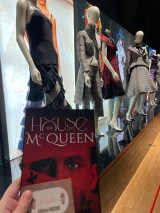
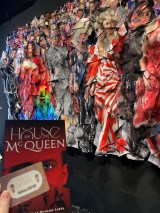
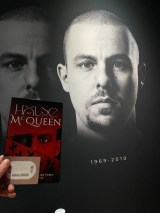
The most interesting thing about House of McQueen, an Off Broadway play examining fashion designer Alexander McQueen, is the way the play focused exclusively on his life and, for the most part, left his life’s work out of it. The story centered on McQueen’s homosexuality, which he seemed to never really struggle with despite everyone in his world having strong feelings. The play indirectly implies that the violence in McQueen’s fashion design might have been an outward manifestation of an internalized self hatred that came from the surrounding world’s bigotry and ignorance. Though not a violent or hateful person, McQueen’s artistic renderings of violence are described as gruesome and grotesque. Yet when I stepped into the exhibition accompanying House of McQueen, I didn’t see violence and pain— like many of the characters in the show, I saw beauty.
The cast was incredibly talented, with each character filling a persona more than a person. Everyone else’s pain seemed distant— either too small to matter or too absurd to be real— McQueen (Luke Newton)’s pain was similar— at moments he was haunted by a very stark reality, at others, there was a feeling floating in the space creating a barely detectable discomfort. His happiness came in sudden flashes of moments and the light in his eyes disappeared as he sold himself out. McQueen struggled with conventionality. He really wasn’t a conventional stereotype of a gay fashion designer or celebrity. He seemed a humble man, despite his accomplishments, and despite the cocaine he really seemed to be working hard. All that mattered was his design and throwing himself into his work— as if to prove through his productivity that there was a place for him in this world.
The design elements of the show itself are simply exquisite, and matched the blocking (Sam Helfrich) with a beautiful precision. Video and projections designer Brad Peterson, and his close collaborators in lighting (Robert Wierzel), sound (G Clausen) and music (Andres Martin), created a world that felt immersive in the way that McQueen’s ideas shaped the creation of the physical space. Costumes (Kay Voyce) tastefully created costumes that supported an aesthetic but didn’t mimic or replicate McQueen’s work. Playwright Darrah Cloud’s intentions seemed to be to find McQueen a delightful, imperfect work of art, rather than delighting in any specific idea he championed or dress he created. McQueen himself was clad in a white t shirt and jeans, as if to say that he is not what he does— he is not the violence he creates or the pain that inspires him. It was deeply moving to see McQueen in his ordinariness— to see the banal nature of his struggles. He was a man fighting to live a life, like any other. Perhaps we all have the capacity to channel our pain into beauty and truth. Though dark in its humor and dry in its wit, House of McQueen tells a wondrous story of a man gone too soon, who wanted to learn everything, everything, everything.
I attended this performance on a press pass from JT Public Relations.
 Pages on Stages